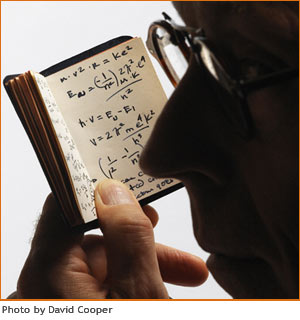
 COPENHAGEN COPENHAGEN
by Michael Frayn
Playhouse Theatre Company
February 26 – March 26
$16-$50
604-873-3311
www.ticketmaster.ca
Michael Frayn's Copenhagen has to be one of
the most surprising international hit plays of our time. Theatrically
unadorned, it consists entirely of two men, the German scientist
Werner Heisenberg and his Danish mentor Niels Bohr, with Bohr's
wife Margarethe sometimes chiming in, talking about nuclear physics
and what might have been said in a ten-minute conversation between
them in German-occupied Copenhagen in 1941. The potential implications
of that conversation were enormous: it may have determined whether
or not the Nazis developed atomic weapons. The moral and ethical
questions raised are also supremely important. Still, Heisenberg
and Bohr are not sufficiently well known historical figures that
many people would be keenly interested in them, and a talky play
about a difficult subject on a bare stage with virtually no action
you'd think would be a tough sell.
The Playhouse has bet that the play's fame plus the cachet of
Canadian superstar Brent Carver will bring its notoriously fickle
audiences flocking. The company has put its money on the right
horse when it comes to the quality of the material. Copenhagen is an intellectual mystery as intelligent, provocative and cerebrally
challenging as advertised. And the performances are very strong.
As Heisenberg, Carver takes some amazing risks in a characterization
that seems at times simpleminded and eccentric but is absolutely
original and tremendously effective. Victor Ertmanis and Susan
Hogan as the Bohrs do terrific work as well. But a good part
of the Saturday night audience at the show I saw was grumbling
at intermission and coughing incessantly over the dialogue--never
a good sign. This is a play that requires concentration and work
from its audience.
The setting of the play is actually an afterlife of some sort.
The characters are ghosts who replay and debate the meaning of
Heisenberg's visit over and over. Why did he come? To try to
enlist Bohr's help in the German nuclear program? Or to subtly
sabotage that program? To try to organize physicists on both
sides of the war to renounce the attempt to develop nuclear weapons?
To try to help save the half-Jewish Bohr? Or to ask for Bohr's
absolution? In the end whose hands were dirtier: the German whose
work led to no one's death or the Dane who was instrumental in
the nuclear deaths of tens of thousands of Japanese civilians?
Heisenberg's most famous accomplishment, establishing the Uncertainty
Principle in physics, becomes the play's primary metaphor for
the essential elusiveness and unknowability of objective truth.
Ertmanis' Bohr is a solid, avuncular character who varies between
obvious affection for his surrogate son and scientific peer,
and frustration at Heisenberg's presumptuousness or naivety or
whatever it is that the younger man brings with him. Margarethe
has little to do in the first act but introduce the two men to
the audience, but in the second Frayn lets her fierce moral indignation
loose on Heisenberg and the political system to which he lends
his science, and Hogan rises to the occasion with a powerful
condemnation of the Nazis' deportation of Denmark's Jews.
And Carver. His Heisenberg is all hesitancy and distraction.
A nervous, almost moronic smile plastered on his face, he glances
obliquely every which way as long as he doesn't have to meet
the others' eyes. There is so much he can't say, and not only
because in 1941 he's being tailed and recorded by the Gestapo.
He loves his country as much as he may dislike its political
system. And it's not clear that even he is certain about his
motives. Like Bohr, science is ultimately the most powerful force
in his life. When he describes his discovery of Uncertainty he
can barely speak of it. He struggles to hold himself together,
as if he is still, after all these years, shattered by his revelation.
Carver's own persona is so likeable that his making Heisenberg
tentative and weird is really the only way to keep the play's
sympathies properly balanced. Not always an easy performance
to watch, it's nevertheless one I won't soon forget.
Glynis Leyshon's production mostly lets the actors do their
thing. Alan Brodie's set consists of three chairs on a small
revolve set upon a larger round platform within a circle of broken
Gothic arches. Above the revolve hangs a chandelier in which
a large bird appears to have built its nest. The semiotics of
this design wasn't very clear to me. The cathedral metaphor appears
a couple of times in the play, but what is most important is
that no props, furniture or set pieces mediate between the actors
and audience. I think the play could be equally effective with
no set at all, especially as the characters are in a kind of
limbo. This being a memory play Brodie's lighting is important,
its changing colours and moods working nicely to help sculpt
the emotion of particular moments. Jeff Toyne's sound design
is less effective. Bach and Beethoven are heard whenever they
are mentioned, along with various ominous sound effects, but
at almost subliminally low volumes. That kind of uncertainty
the play could do without.
Jerry Wasserman |