|  THE
COUNTRY THE
COUNTRY
by Martin Crimp
The Mentors' Project
Performance Works
Granville Island
February 22-March 6
$22/$20
604 257-0366
www.festivalboxoffice.ca
Although first produced at London’s Royal Court in 2000,
this play feels like it could have been written any time between
about 1960 and 1978. That’s when its cousins first appeared:
Harold Pinter’s The Caretaker, Edward Albee’s The
American Dream, and Sam Shepard’s Buried
Child. In all
those plays and The Country, a repressed and dysfunctional family
unit/home, which stands in for the larger society, is shaken
up by a mysterious intruder. The
Country also shares with these
other plays, but especially The
Caretaker, a semi-absurdist style
in which dialogue is clipped, rhythmic, and repetitious, or surreally
off the wall, and often punctuated by long, Pinteresque pauses.
Tension underlying the dialogue and behaviour hints at a subtext
deeper and richer than the often banal surface conversations
and action.
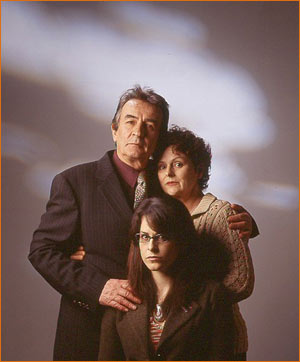
Richard, a doctor (Eric Schneider), and his wife Corinne (Gabrielle
Rose) have recently moved to the English countryside from the
city. He’s having some problems with his practice. Both
are obviously having problems with their marriage. Corinne seems
right on the edge of hysteria. When she asks him to kiss her,
he says he already has, or changes the subject. Hmmm… Their
faux pastoral life, the ironies of which are heavily underlined
by repeated references to Virgil’s poetry, is interrupted
by the arrival of Rebecca (Nicole Leroux), an aggressive young
woman involved with Richard in ways I won’t reveal, who
threatens to take over their home, if not their lives. Complications
ensue, but in the play’s final image Corinne speaks of
a stone that has devoured her heart. Nothing much seems to have
changed.
A chilly little play, The Country didn’t really show or
tell me much that I hadn’t seen or heard before, but the
first-rate cast makes it worthwhile. Tom Kerr’s production
clips along nicely, capturing the rhythms of banality and bad
marriage in the dialogue between Richard and Corinne. With his
somewhat mannered acting style, Schneider is right at home in
this devious doctor. Rose, one of the best actors around, is
always a treat to watch, especially when she lets Corinne’s
rage come out from under the English repression. The intruder
is generally the most problematic character in these plays and
Rebecca is no exception. What brings her there? What keeps her
there? What are her motivations? None of it is very clear except
that she is one angry, hostile, manipulative young thang. I’d
have liked to see Leroux try to moderate the ice queen just a
little, to make her even minimally sympathetic. But empathy for
the characters is never a high priority in this genre.
This country is worth a visit but you definitely wouldn’t
want to live there.
Jerry Wasserman
|