| LAST
CALL…A POST-NUCLEAR CABARET
Book and lyrics by Morris Panych
Original music by Ken MacDonald
Quintessence Musical Theatre
Waterfront Theatre
Granville Island
July 7-23
604.760.9050
www.quintessencemusicals.com
Last Call was the play
that blasted Morris Panych onto the map in 1982. With text and lyrics
by Panych and music by Ken MacDonald, the “Post-Nuclear Cabaret”
was a hit for the two of them in Vancouver, followed by a national
tour and CBC television production.
Samuel Beckett meets Kurt Weill in this bleak comic satire of human
folly and persistence, set amid the ruins of a Vancouver nightclub
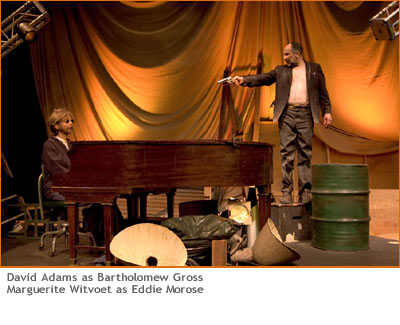
after a nuclear holocaust. Panych and MacDonald were Bart Gross
and Eddie Morose, the one suffering from radiation poisoning, the
other blinded by the blast. In Quintessence Musical Theatre’s
current revival, David Adams plays Gross and Marguerite Witvoet
is Morose.
They put on a cabaret in the hopes of attracting other survivors.
Gross sings and dances, Morose sings and plays piano. All the world’s
a stage and life is a cabaret. Gross directs the operation, not
just because Morose is blind but because Gross has a gun. As one
of his lyrics says, “the one with the gun calls the shot.”
Questions about whether humans naturally crave power and are inherently
violent and destructive run through the play. So does the existential
theme that characterizes all Panych’s work—the meaning
of life in the face of death—played out, as so often in his
drama, in the relationship between two people.
Like Beckett’s Didi and Gogo in
Waiting for Godot or Hamm and Clov from Endgame,
Gross and Morose are utterly interdependent yet can’t stand
each other. One is cynical, the other hopeful. They change positions
by the end of the play but nothing is resolved. Not even whether
there will be a tomorrow.
Panych finds dark Beckettian humour in the absurdity of the human
condition. His lyrics have the topical wit and clever rhymes of
a Tom Lehrer and gain added edge from the cabaret quality of MacDonald’s
Weillian score. Adams, an excellent actor with a rich, resonant
voice, delivers Gross’s songs in energetic vaudevillian style
to Witvoet’s fine piano accompaniment.
Some of the cleverest lyrics are found in a musical travelogue
in which they imagine post-nuclear life elsewhere: “Throughout
Spain radiation is in the air/And it’s plain all the Spanish
will lose their hair/ If it rains/And rain it will/ So who the hell
needs Barbers in Seville?” Their stop in England has a chilling
topicality: “There goes Leicester/ And Manchester/ And a little
bit of Wales./ Is that Hampshire?/ That’s for damn sure./
Goodness, how Britannia sails!”
The fear of atomic war nevertheless dates the play a little—how
soon we forget. And the energy in Andy Toth’s production waxes
and wanes, partly due to Marguerite Witvoet’s light voice
and low-key presence. It’s hard not to be morose in the face
of nuclear death, but it’s much more fun to sing our way to
the apocalypse being gross.
Jerry Wasserman |