THEATRE REVIEW
SEPTEMBER 2025 | Volume 255
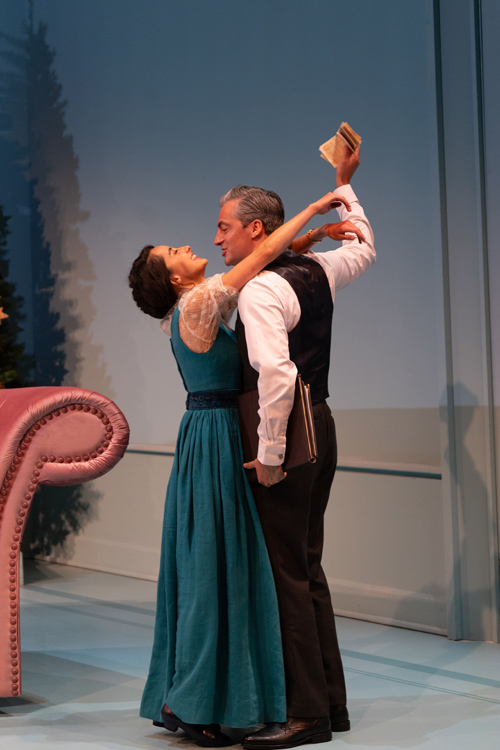
Alexandra Lainfiesta and Daniel Briere in A Doll’s House; photography by
Moonrider Productions
A Doll's House
by Henrik Ibsen, adapted by Amy Herzog
Arts Club Theatre Company
Stanley Industrial Alliance Stage
Sept. 4-Oct. 5
From $29
www.artsclub.com or 604-687-1644
BUY TICKETS
Ibsen’s A Doll’s House was revolutionary when first performed in 1879. Epitomizing the relatively new style of theatrical realism, it told the story of Nora Helmer, a bourgeois Norwegian woman who comes to realize that her father, first, and now her husband have infantilized her, and that her life as a wife and mother has been a lie. Ready to sacrifice everything for her husband, whose life she has saved by secretly going into debt, she’s shocked into awareness by his callous response to the unraveling of her secret. In the end she does the unthinkable, leaving him and her children in order to find herself.
Of all the plays that emerged out of that explosion of late-19th century realism, A Doll’s House continues to be the most often performed. Its theme of women’s liberation remains current and urgent, but its style has felt increasingly clunky. English translations seem either too formal or awkwardly colloquial. Ibsen’s contrivedborrowings from melodrama, the total blindness of Nora’s husband Torvald to his own extreme sexism, and Nora’s strained behaviour have become increasingly difficult for contemporary audiences to digest.
Hence, A Doll’s House, Pt. 2, Lucas Hnath’spowerful sequel in which Nora and Torvald argue out their differences fifteen years later, which was such a hit here last season. I’d also point to the two mainstage Shakespeares at this summer’s Bard on the Beach, Much Ado About Nothing and The Two Gentlemen of Verona. Both plays feature young women unquestioningly marrying men who seriously abused them earlier in the play. Both Bard productions significantly revise the Shakespearian texts to give the women a voice and/or an alternative. For contemporary theatre-makers no classic or iconic text is sacred.
This brings me (finally) to the Arts Club’s A Doll’s House, a co-production with Theatre Calgary directed by Anita Rochon, advertised as being “A New Version by [American playwright] Amy Herzog.” There’s not really a lot new about this version. Herzog has cut some of Ibsen’s wordiness and colloquialized some, but not all, of his 150-year-old language. “Good night, buddy,” says Torvald (Daniel Briere) to his dying friend Dr. Rank (Marcus Youssef).
When Nora (Alexandra Lainfiesta), feeling exhilarated, wants to say something “shocking” in front of her friends Dr. Rank and Mrs. Linde (Carmela Sison), she shouts out, “Fuck!” And when Torvald discovers that Norahas forged her father’s signature on the promissory note to get the loan that saved him, he calls her a “stupid bitch.” These rare diversions from the characters’ more formal speech patterns, as well as their period costumes (by RalamyKneeshaw), justsound anachronistic.
My overriding impression of this production is that a varying series of contrasting styles and strategies fail to harmonize in any way that helps to tell Nora’s story. Amir Ofek’s striking set is a huge sitting room of skewed angles furnished with only a large sofa and a Christmas tree. Dwarfing Nora, it does suggest the interior of a dollhouse. But at the opening, a huge sheet mysteriously covering the sofa is pulled off by a stage hand who also sets up the tree while he’s listening to rap music—the only metatheatrical moment in the production.
Malcolm Dow’s music plays throughout the show, beneath the dialogue, getting louder and more melodramatic in moments of high tension. The melodrama is most intense when the putative villain, Krogstad (Ron Pederson), enters or is onstage. Pederson plays him with slumping shoulders and bowed head, the broken man who has nothing to lose and would blackmail Nora to get back his job at Torvald’s bank. NardaMcCarroll’s lighting ups the ante on the melodrama with heavily shadowed, snap-lit entrances accompanied by a loud sound effect. But sometimes the lighting is explicitly expressionistic, casting ominously large dark shadows, complementing the unnatural angles of the room’s walls. I could understand an expressionistic production of A Doll’s House. But expressionism is nowhere else to be found here.
Director Rochon leans into the melodrama and has Lainfiesta’s Nora do the same, as if Nora and Krogstad share a theatrical universe separate from the others. This changes at the end.When Nora insists that Torvald sit down and listen to her, the play returns to realist conversation—although that ending drags after all the previous intensity.The trouble with melodrama here is two-fold. It’s an outmoded form unsuitedto the play’s psychological realism and socio-political arguments. And to a contemporary audience it often seems comically ludicrous. Although a few obviously intentional comic moments are sprinkled throughout the production, many more laughs occurred on opening night in places not meant to be funny.
Lainfiesta has shown herself to be a fine actor in other shows in recent years. I don’t think this staging does her, or Ibsen’s drama, justice.
get in touch with vancouverplays:
vancouverplays
Vancouver's arts and culture website providing theatre news, previews and reviews