THEATRE REVIEW
JULY 2026 | Volume 264
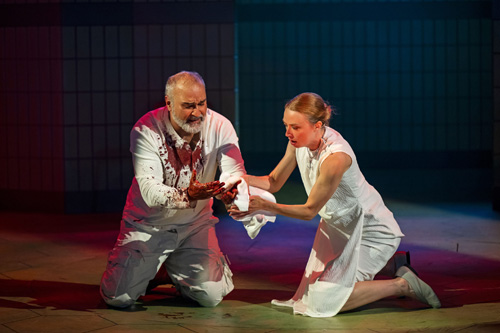
Munish Sharma and Tess Degenstein. Photo by Emily Cooper.
Macbeth
by William Shakespeare
Bard on the Beach Shakespear Festival
Sen̓áḵw/Vanier Park
June 9-Sept 19
From $30
www.bardonthebeach.org or 604-739-0559
BUY TICKETS
Now in its 37th season and one of the most successful theatre companies in western Canada, Bard on the Beachhas gotten bold in its treatment of Shakespeare’s plays: casting across genders, altering and updating the scripts, adding musical numbers. This has sometimes proven revelatory as in the case of director Daryl Cloran’s brilliant Beatles-inflected As You Like It. But messing around with the great tragedies can be risky.
I came to director Stephen Drover’s Macbeth hoping he could bring the same magic to this darkest and most brutal Shakespeare tragedy as he did with his fresh, dynamic 2024 production of Hamlet without any loss of that play’s essential wonders. His Macbeth has its powerful, eye-opening individual moments and some terrific acting, especially Munish Sharma in the title role. But I don’t know what to make of the world Drover has created onstage. The production is a stylistic mess.
But first the actors. Sharma builds his character beautifully. Macbeth develops from a relatively stable warrior, somewhat surprised at becoming Thane of Cawdor, to taking his wife’s bait and deciding to kill King Duncan, at which point he begins to agonize. After the murder his agony builds: he’s haunted, wracked by guilt. The notion that he’ll “sleep no more” feels literal. His decision to kills Banquo and his reaction to Banquo’s ghost kick his madness and near-hysteria into high gear. By the time he decides to go after Macduff’s family he has become a cold-blooded killing machine. Even the news of his wife’s death barely moves him.He’s shattered, numb, his life “a tale told by an idiot” (the play’s greatest speech, literally upstaged by Drover’s having dead Lady Macbeth recite part of it on the ramparts overlooking Macbeth). In the face of Macduff’s challenge and Birnam Wood’s coming to Dunsinane, he re-gathers his warrior powers for one last great fight to the death. Sharma pays off at every key point in the journey. His is a memorable Macbeth.
On Lady Macbeth’s first appearance I had my doubts. Tess Degenstein is tall and thin. Wearing a long white dress with flat shoes and giggling as she offers the proposition of regicide to Macbeth, she appears to lack the gravitas usually associated with this memorable character. But once she has Macbeth on the hook, she’s relentless, even if momentarily freaked out when Macbeth has his nightmarish vision of a dagger in the air. Her “out damned spot” scene is punctuated by terrified screams, as terrifying as it should be.
Of the secondary characters I liked Anthony Santiago’s Duncan best, with his vocal clarity and dignity. Sebastian Kroon’s Banquo is most effective after his death. His ghostly presence at Macbeth’s banquet is genuinely scary.
But I’m at a loss for the rationale of many of Drover’s stylistic choices. Amir Ofek’s green tiled set appears to be a locker room or basement. It looks nothing like a castle home where nobles like Macbeth and his Lady would live, and it certainly bears no resemblance to the “blasted heath” where Macbeth and Banquo first confront the Weird Sisters, or what are simply called “figures” in the program and “the three” on stage. One of the pleasures of seeing multiple productions of Macbeth is seeing the different ways each one approaches these famous archetypal characters. They are also, besides Lady Macbeth, the best female roles in the script.
Here, they are clearly not female, which is fine, but they are not really anything. Dressed in rags and goblin-like masks, the figures just stand and walk very slowly. When they speak, their voices are loudly amplified, distorted and deepened to sound like Darth Vader. The three excellent actors playing these roles have almost nothing to do.The scenes are dully supernatural and inhuman, as if AI has come to Bard on the Beach.
There is a potentially interesting futuristic/retro Blade Runner quality to the play’s opening costumes and the bags of loot that Macbeth and Banquo sift through after their victory. They pull out metallic junk, a bent street sign, and some kind of portable cassette player that plays Piaf’s “No Regrets,” a little on the nose but provocative.
But there is no consistency to Alaia Hamer’s costumes. In white jumpsuits the guests in Macbeth’s castle look like auto mechanics gathered around the table at the banquet. When Malcolm (Sara Vickruck) appears at the end, rallying the army that will destroy Macbeth and restore the rightful monarchy, the character looks nothing like the inspirational man who would be king nor a battle-scarred veteran of the war, but like someone who threw on a sloppy sweatshirt for the scene.
Finally, Drover has Mary Jane Coomber’s spooky, scary sound cues play too loudly and frequently throughout. Those sounds should support the power of Shakespeare’s words in the mouths of actors who can make their presence felt to an audience, not substitute for them.
Macbeth remains a great play in this production. Just keep following the central characters’ journeys into hell.
get in touch with vancouverplays:
vancouverplays
Vancouver's arts and culture website providing theatre news, previews and reviews