THEATRE REVIEW
MARCH 2026 | Volume 261
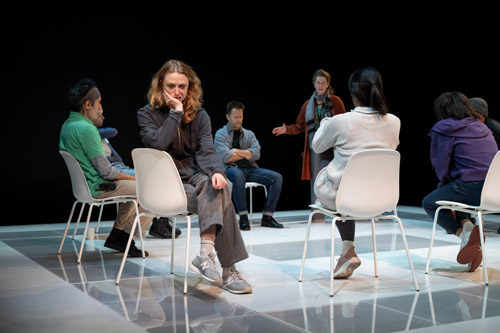
People, Places & Things
by Duncan Macmillan
The Search Party
The Cultch Historic Theatre
Mar. 10-22
From $35
www.thecultch.com or 604-251-1363
BUY TICKETS
Reckoning with Rehab: The Search Party’s People, Places & Things
British playwright Duncan Macmillan’s People, Places & Things is a spectacular solo turn disguised as an ensemble play. Mindy Parfitt’s Search Party production--part of The Cultch’s Warrior Festival--never quite finds the harsh reality at the core of the addiction story, despite some solid acting and strong theatrical moments. The central role is a major part of the problem as are the ellipses in Macmillan’s script.
An actress, alternately calling herself Nina, Emma and Sarah (Tess Degenstein), has fallen deep into alcoholism and drug addiction, and her life and career havecratered. She reluctantly checks into rehabbut looks for a quick fix, resisting acknowledging her addictions or investigating their roots. Continued probing by a doctor and the group therapist (both played by Jennifer Clement, who also plays her mother), and another patient, Mark (Robert Salvador), who sees through her shenanigans, fails to move Sarah. She refuses to be forthright in the group sessions with the other patients.
Eventually, after many weeks in therapy, she breaks through her denial, admits to her existential crisis and attempts to heal. I won’t reveal the ending, which provides a provocative but, I think, unsatisfying conclusion to her journey. Maybe because, as friends in similar situations have told me, addiction is forever.
Clement and Salvador are both very good as Sarah’s primary interrogators. Kevin McNulty has a couple of strong turns as an overwrought patient and Sarah’s father, and Stephen Lobo, as the patient/nurse Foster, has one of the production’s sweet understated moments. “How are you feeling?” he asks Sarah. “Like the worst is over,” she responds, and he very quietly laughs at her naivety.
The rest of the patients—played by Donna Soares, Monice Peter, Jess McLeod, Jesse Lipscombe and Aidan Currie (who makes the most of his moment)—are virtually anonymous except for one session where each gets a couple of lines to confess their addiction. These powerful moments are cut off almost immediately. More opportunities to round out their characters, to do what Sarah is continually urged to do, would have helped cement the reality of the group, which never quite shakes the sense of artifice. In Sarah’s hallucinatory scenes, Parfitt puts them in blonde wigs like Degenstein’s hair and has them jumping around to Kate De Lorme’s earsplitting sound design and Sophie Tang’s lighting effects, strong images but ultimately an underutilization of a lot of fine acting talent.
At the heart of the play, Degenstein’s manic physical performance too often overwhelms what should be a focus on Sarah’s psychological issues. She has interesting things to say about her self-esteem: “Drugs and alcohol have always loved me back.” And her acting: “If I’m not in character, I’m not sure I’m really there.” And the trauma of her brother’s death. But in the first act especially, Degenstein staggers and stumbles around the stage, drunk and jonesing, nervously playing with her hair, never standing still. In situations like that, the director’s first job is to pull the actor back.
Late in the play, when the actor and character find some equilibrium,the real emotion comes pouring out. Degenstein settles down and in, and we get to see what a fine performer she is.
get in touch with vancouverplays:
vancouverplays
Vancouver's arts and culture website providing theatre news, previews and reviews