THEATRE REVIEW
APRIL 2026 | Volume 262
La Bohème
Music by Giacomo Puccini
Libretto by Luigi Illica and Giuseppe Giacosa
Vancouver Opera
Queen Elizabeth Theatre
April 25-May 3
BUY TICKETS
Confession: I know nothing about opera and I’m not a fan. But as an aficionado of live theatre, including musicals, and a frequent theatrical flyer, I ought to be able to say something about the Vancouver Opera production of Puccini’s La Bohème, which I saw opening night.
Here’s what I knew about La Bohème going in: it’s sung in Italian; its tragic protagonist, Mimi, dies of consumption; and the contemporary musical Rent is adapted from it.
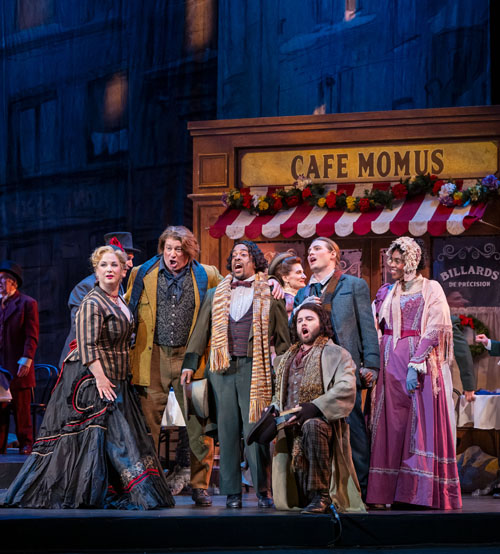
Here are my observations and what I learned. First, despite the sad ending, La Bohème is almost entirely a comedy with a love story built in. The four young guys who live together in an 1890s Paris tenement—painter Marcello (Gregory Dahl), writer Rodolfo (Matthew White), philosopher Colline (Alex Halliday) and musician Schaunard (Justin Welsh)—joke around, rip off their landlord, and eat, drink and be merry despite their poverty. Marcello’s on-again off-again girlfriend Musetta (Lara Ciekiewicz) is a party girl who rips off her rich old suitors. The jocular behaviour frames and counterpoints the Rodolfo-Mimi (Jonelle Sills) love story. Only in the final scene does the comedy disappear.
The love story is told in shorthand. When Rodolfo and Mimi meet for the first time, they fall in love even quicker than Romeo and Juliet. Their relationship is sung without much detail except that their love is instantly deep and passionate. In fact the entire plot and all the characters lack depth and development. Despite there being only five performances, two singers alternate in the roles of Rodolfo (White and Zachary Rioux) and Mimi (Sills and Lucia Caesaroni).
Yet none of that matters much because it’s all about the operatic voices and the singing, which are pretty magnificent. The lovers—White’s tenor and Sills’ soprano—are especially gorgeous. The opera is fully sung; there is no spoken dialogue. Because I don’t really understand the emotional vocabulary of opera, I don’t get why relatively ordinary communication and moments of heightened emotion sometimes sound much the same. Mimi, for instance, seems to hit her screaming high notes not just at her emotional heights of love and depths of despair, but even at the beginning when she’s just asking Rodolfo to light her candle (ooh – I didn’t realize the obvious symbolism of that until just now). Maybe my untrained ear just doesn’t recognize subtle vocal distinctions. Anyway, those two leads are knockout vocalists. The baritone and bass voices of the other three guys are also rich and impressive.
The second act features a huge, colourfully dressed chorus for the Christmas Eve celebration in the Parisian streets. I’m guessing that this kind of spectacle is de rigeur for opera. It enhances the comic tone but adds nothing to the plot. I also found the English surtitles stilted, but I don’t know if that’s the original libretto or the translation.
The four-act opera with one intermission has relatively simple sets (borrowed from New Orleans Opera; the costumes are borrowed from Sarasota Opera). But rather than the two scene-changes being done quickly with the curtain remaining open, as would happen in a straight theatre production, the curtain comes down each time for five minutes or so with a projection saying, “Pause. Please remain seated.” During that interval information about the passing time and new scene is projected onto the curtain.
So for this chronic theatregoer but opera newbie, the different conventions are somewhat jarring. But if you want to hear magnificent voice, La Bohème is a very good bet.
get in touch with vancouverplays:
vancouverplays
Vancouver's arts and culture website providing theatre news, previews and reviews